Whilst an understandable response to local businesses petition, unfortunately this is likely to be £35,000 of public money which could have been much better spent.
See this article:
http://www.wandsworthguardian.co.uk/news/10342138.New___35_000_initiative_brings_half_price_parking_to_Tooting/
Back in the Autumn a petition went forward from local businesses regarding car parking charges. A significant number of them are of the opinion that low cost car parking provision is essential for the well-being of the high street, and that empty car parking bays on neighbouring streets is a sign that the pricing is too high, thus deterring shoppers from their stores.
In spite of the evidence of a local report* commissioned on their behalf only a few years ago which shows over 80% of their customers, walk, use public transport and walk, or cycle and then walk into their businesses.
Less than 1 in 5 shoppers drives a car, or is a passenger in a car or van to Tooting to shop, and then, yes they walk into local businesses.
*See the report on the link below 'Tooting Town Centre Gap Analysis study 2009'
http://ww3.wandsworth.gov.uk/committ/%28S%28j14jbcuxyyc5p245j4bn0omj%29%29/documents/s9480/09-1005%20-%20Experian%20Gap%20Analysis%20Study%20report.pdf
Granted not everyone walks, some people are not able to, and use mobility scooters, but the principle remains.
I fully understand that the council needs to listen to the demands of it's residents and businesses. However I also believe, that they have a duty to evaluate the evidence, and make decisions which reflect that evidence base.
The only outcome which will be clearly measurable by the drop in car parking charges will be the number of bays which are available. Given that a minority of shoppers choose to visit Tooting in this way the difference to businesses will be negligible at best.
One result may well be an increase in the numbers of people encouraged to drive to Tooting, instead of using the excellent public transport links, and indeed walking or cycling. This will result in a less pleasant shopping experience for all as the roads become more congested, noisy and more polluted.
I want our town centre to thrive, and really want to support local businesses, as I believe the council does too. However, I do think when beliefs fly in the face of the evidence that we have a duty to challenge them and if we go ahead with trials have robust ways of measuring the outcomes. I don't know how this trial will be measured, and I'm not convinced there is a way that it can be effectively measured.
If you know how it could be, do post a comment below.
Also if you have 30mins it's well worth listening to this podcast on Freakonomics Radio 'Parking is Hell':
http://transportationnation.org/2013/03/15/freakonomics-radio-parking-is-hell/
Tuesday, 9 April 2013

Thursday, 21 March 2013
Safer Lorries - open letter to Wandsworth Council
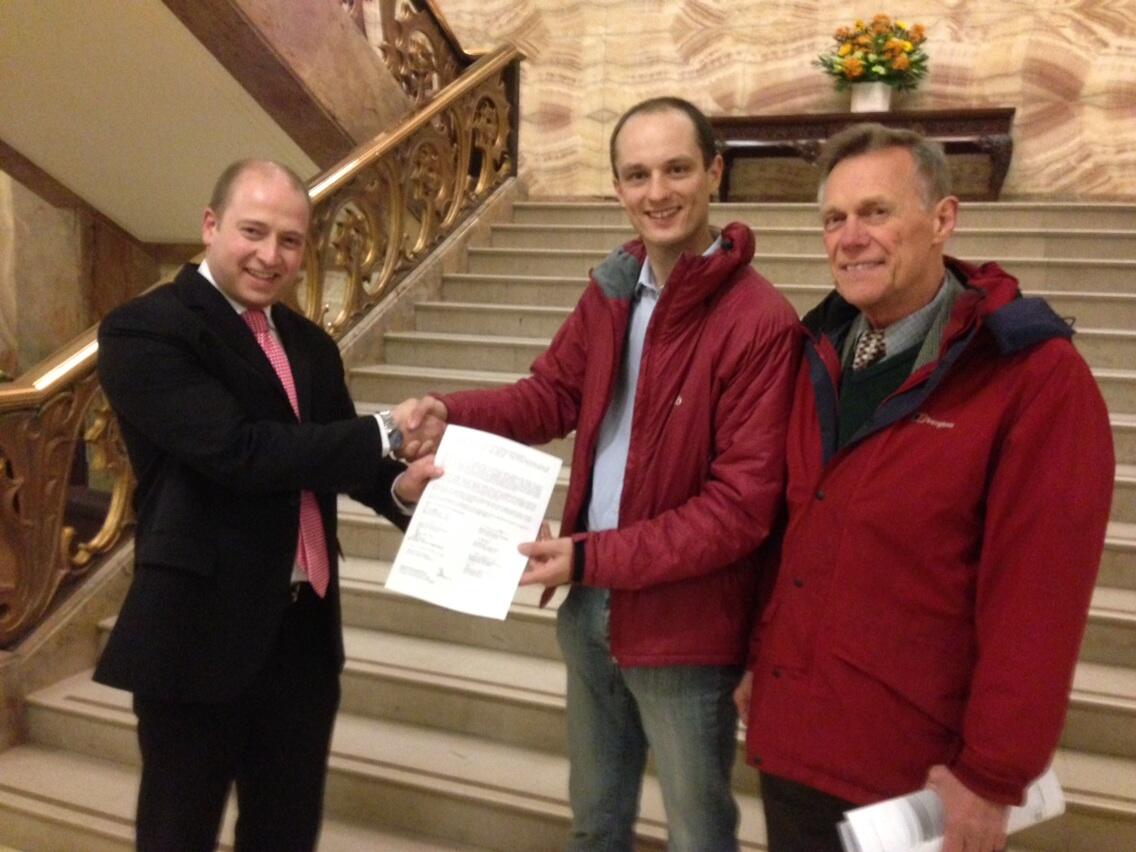 |
| Cllr Russell King, Jon Irwin (Co-chair WEF), Robert Molteno (Secretary Wandsworth Living Streets) |
Yesterday evening I went to Wandsworth Town Hall, and presented an open letter to the council.
As some of you may already know, lorries and HGVs are disproportionately involved in fatal collisions on our streets. In part due to their design, where many of the drivers have no visibility up to 4m in front of their cab.
In Wandsworth there have been 3 elderly people who have been killed by lorries in the past year, two incidents happening very close to me in Tooting.
Feb 17 2012 - Man decapitated after being run over by lorry
May 18 2012 - Elderly man dies after being crushed under truck
Sept 28 2012 - Pensioner killed by lorry in Putney High Street
Aside from lorries being involved in all 3 fatalities, each of the men involved were of advanced age. Unfortunately these deaths, in part due to the age of the victims, in part to the ubiquity of death and injuries on our streets, can too often become 'invisible'.
London Cycling Campaign (LCC) launched a 'Safer Lorries' campaign earlier this year, however, as we know from our local recent history not only cyclists are at risk from lorries on our streets. With this in mind, together with other local groups, the letter below was drafted.
I hope that the widespread support shown including; Age UK Wandsworth, Friends of the Earth Wandsworth, the Putney Society, Transition Town Tooting, Wandsworth Cycling Campaign, Wandsworth Living Streets, the Wandsworth Society, and Wandsworth Environment Forum, will help illustrate the strong desire from the local community for our council to take action which will deliver safer streets for residents, visitors and people who work in the borough alike in the long term.

We can't bring people back to life, but we can learn how to reduce road danger, in doing so help change our streets to make them safer for all. Yesterday also saw London Cycling Campaign publish the following proposals of how safer lorries could be designed. This is how LCC suggest they could look like based on existing technology and design principles:
 |
| Graphic produced by http://www.releasethechicken.com/ for LCC |
You can view an animation of the lorry here.
Thursday, 14 March 2013
From Balham High Road to Balham Boulevard
A vision who's time has come. Incredibly excited about this project, which I put forward in the autumn to Wandsworth Council.
This afternoon I saw this tweet:
In case you are wondering what I'm excited about, don't worry hopefully the following pictures will explain. If you aren't familiar with this part of London, here is a streetview picture to give you an idea.
View Larger Map
I visited Paris last year, and took a picture of this, as I thought that this kind of idea could be replicated here in London.

So I took to my spreadsheet and google satellite view. Measured up the street, and then did this roughly to scale map. On the left is the crossing where Balham Tube station is, so under the bridge for those who know it.

Then, having a plan of what space is available, I played around, and came up with the plans in the pictures below.


The parking bays are set away from the pavement. The black dots along the service road, are to illustrate that if you are in a car/van, you will need to exit once you've been to the shop, and re-join the main road. Doing the scheme in this way results in a very small reduction in road capacity (technical term for how many motor vehicles the road can hold).
I checked with Wandsworth Cycling Campaign @Wandscyclist and Wandsworth Living Streets @WandsLS first to iron out any potential issues. Now it seems that Balham Town Centre Partnership (@Balhamtcp), and Balham Town Centre Manager (@Balhamtcm) are now on-board.
This afternoon I saw this tweet:
Great meeting with @balhamtcm and chairs of @balhamtcp. Total support for the Balham Boulevard scheme. Full steam ahead.
— Russell King (@WandsworthRKing) March 14, 2013
In case you are wondering what I'm excited about, don't worry hopefully the following pictures will explain. If you aren't familiar with this part of London, here is a streetview picture to give you an idea.
View Larger Map
I visited Paris last year, and took a picture of this, as I thought that this kind of idea could be replicated here in London.
So I took to my spreadsheet and google satellite view. Measured up the street, and then did this roughly to scale map. On the left is the crossing where Balham Tube station is, so under the bridge for those who know it.
Then, having a plan of what space is available, I played around, and came up with the plans in the pictures below.
The light blue is what I'm terming a 'service road'. It will be
essentially segregated cycle route most of the time, but does allow
people in cars/vans to use it when doing deliveries, or dropping into
the shops/cafes/restaurants.
The parking bays are set away from the pavement. The black dots along the service road, are to illustrate that if you are in a car/van, you will need to exit once you've been to the shop, and re-join the main road. Doing the scheme in this way results in a very small reduction in road capacity (technical term for how many motor vehicles the road can hold).
I checked with Wandsworth Cycling Campaign @Wandscyclist and Wandsworth Living Streets @WandsLS first to iron out any potential issues. Now it seems that Balham Town Centre Partnership (@Balhamtcp), and Balham Town Centre Manager (@Balhamtcm) are now on-board.
Update 21st April 2013
I was sent an email earlier from someone who lives in Balham. They received a Wandsworth Conservatives Borough newsletter today which includes the following text:
"Your views on Balham Boulevard plans
Wandsworth Council is pulling together plans to create a Paris-style boulevard on the wide stretch of Balham High Road between Balham Station and Ritherdon Road.
The plans, which will be submitted to Transport for London, will separate cyclists from other traffic and enable a more continental-style 'cafe culture'. We'd like to hear what you think of the plans - please get in touch using the form below or the details above."
The email that they have asked for feedback to is: heretohelp@wandsworthconservatives.com
If you are supportive of the proposals, please do let them know. Worthwhile also copying in your local councillor and our London Assembly Member Richard Tracey as TfL will need to give the go-ahead for this project.
richard.tracey@london.gov.uk
Good to see that campaigning can deliver results.
Tuesday, 22 January 2013
Rat-running time for a different solution
Seeing the news published by the council today that "Public say no to Earlsfield traffic changes" has spurred me on to write this.
The problem faced by the residents of Earlsfield is one which people face across the UK, and no doubt in other countries too. As main roads become congested with more and more (motor) traffic, those drivers seek alternative routes to travel along. In the case of Earlsfield, those alternative routes are clearly residential streets.
My understanding of the current scenario is as follows:
End result = Residents reject proposed changes, problem remains, time and money wasted.
My main issues with this process is that the public consultation totally fails to consult with the public in question. There is no exchange of views, both from the officers with the residents or vis-a-versa. Also the process takes so long, that the impetus from the original petition may have been forgotten by the time these changes are proposed. The changes are also usually proposed as permanent, which can be very unsettling if you feel that they may not work.
A different approach - A possible Solution
In light of a similar outcome on my residential streets, I conducted a petition which asks the council to trial a solution. In excess of 90% of the people asked were happy to sign. They can see that there is a problem, we don't all agree that my proposed solution will work, but we all recognise that if we don't change anything then nothing will change.
Here is my petition form
I'm waiting for the officers locally to report back. I'm confident that the changes will work, but to really be sure, we need to see how people react with them on the ground.
I'd really like to help others in Wandsworth improve their streets. On my patch, 3 consultations have been done in 10 years. That is a lot of time wasted as well as money, with all the problems still with us.
The right solutions could have been proposed before, but we are naturally hesitant/concerned about change, and whilst change could be good people often think 'better the devil I know'.
If the proposed change is temporary, to allow people the opportunity to experience something different without the fear presented by permanent change and it works, they will want to keep it.
If you'd like some help putting together something like this for your streets, let me know. If several different people could work on similar petitions for their local streets, we could change the streets quite quickly with a lot of local support.
Drop me a line if you are interested.
The problem faced by the residents of Earlsfield is one which people face across the UK, and no doubt in other countries too. As main roads become congested with more and more (motor) traffic, those drivers seek alternative routes to travel along. In the case of Earlsfield, those alternative routes are clearly residential streets.
My understanding of the current scenario is as follows:
- Resident speaks to local Councillor (Cllr)
- Cllr tells resident to do a petition to show support
- Resident collects signatures for their petition
- Resident returns petition to Cllr
- Cllr presents petition at full council
- Next transport committee meeting, petition noted, officers asked to work on it.
- Depending on officer workload, several committee meetings later, report presented recommending a public consultation.
- Data gathered if needs be, proposed solution worked up by highways officers.
- Consultation goes out to key stakeholders first, then shared with wider public.
- Local residents are given a take it or leave it option, which proposes change to stop the problem.
End result = Residents reject proposed changes, problem remains, time and money wasted.
My main issues with this process is that the public consultation totally fails to consult with the public in question. There is no exchange of views, both from the officers with the residents or vis-a-versa. Also the process takes so long, that the impetus from the original petition may have been forgotten by the time these changes are proposed. The changes are also usually proposed as permanent, which can be very unsettling if you feel that they may not work.
A different approach - A possible Solution
In light of a similar outcome on my residential streets, I conducted a petition which asks the council to trial a solution. In excess of 90% of the people asked were happy to sign. They can see that there is a problem, we don't all agree that my proposed solution will work, but we all recognise that if we don't change anything then nothing will change.
Here is my petition form
I'm waiting for the officers locally to report back. I'm confident that the changes will work, but to really be sure, we need to see how people react with them on the ground.
I'd really like to help others in Wandsworth improve their streets. On my patch, 3 consultations have been done in 10 years. That is a lot of time wasted as well as money, with all the problems still with us.
The right solutions could have been proposed before, but we are naturally hesitant/concerned about change, and whilst change could be good people often think 'better the devil I know'.
If the proposed change is temporary, to allow people the opportunity to experience something different without the fear presented by permanent change and it works, they will want to keep it.
If you'd like some help putting together something like this for your streets, let me know. If several different people could work on similar petitions for their local streets, we could change the streets quite quickly with a lot of local support.
Drop me a line if you are interested.
Monday, 19 March 2012
Cycle incident report or shared path on Tooting Common?
Local readers may have seen that recently the white lines on the shared (pedestrian/cyclist) path alongside Tooting common have been re-done.
On viewing the original picture my girlfriend commented that it looks just like someone has done a drawing after having had a collision and is trying to explain how it occurred.
It could go something like this:
I was cycling along on the marked side of the shared route one morning. There were people walking along too, as it was a nice day, when suddenly I had to take evasive action to miss a pedestrian who was walking towards me.
Unfortunately there was another cyclist on the other side which is where the collision happened.


Don't know about you, but I think that the path is really quite narrow to warrant having a line separating it down the middle. Given that the council doesn't seem to know if they want cyclists on the east or west side of the path, perhaps it would be easier to have something like this without a separating line instead?

Think that it could be due to the parks maintenance vehicles which drive up and down the path. Perhaps lighter vehicles could be used, or better foundations for the path could be done. Walking/cycling results in very little wear & tear.
Thursday, 8 March 2012
Assembly member Tracy gives his views on cycling infrastructure
On the 5th of January I asked our Assembly member Richard Tracey the following questions, to save you reading too much I've edited the email, with the full copy of the letter and responses at the bottom of the post.
1. Do you not think that the shape and size of the blind spot of an HGV is almost identical to the layout of cycle infrastructure?
2. Given that TfL is aware of physical segregation methods used in Holland, and their impressive low casualty rates for cyclists and indeed pedestrians, why aren't we using their knowledge to make London's roads safer?
3. Do you think that given their success both in the limited locations where they have been implemented here in London, and nationally in Holland that providing a kerb between the cycle and other forms of transport and separate light phases at junctions for cyclists and other vehicles should be something that TfL should implement across London?
Mr Tracey originally forwarded me TfL's response without his own views. I asked if he could cover that, and he was kind enough to send through this.
"I think I should make it clear that I am not a cyclist, nor have I ridden a cycle for very many years. I travel by public transport, buses and trains, most of my time, as well as walking a good deal, although I do own a car and have many years of experience as a road user.
...The only areas on which I will comment are safety and respect among road users, and to that extent I have supported the Times conducting its debate.
...I hear very often from pedestrians and others that they find cyclists extremely aggressive to them. I think the Mayor's point about avoiding conflict are very relevant in all this.
I hope this is helpful to you, both in passing on what I hear from others and giving you my own perspective."
First point to make is the very welcome support of our Assembly member for The Times campaign. Secondly we have further clarification from TfL on the issues raised.
So TfL's abridged answer to query no 1 (full copy, at end of post)
"Any cycle lanes or surfacing implemented as part of Barclays Cycle Superhighways are a minimum of 1.5 metres wide, so we do not think it is correct to say Barclays Cycle Superhighways encourage cyclists to "hug the kerb".
Cyclists are most at risk from left-turning HGVs. At the junctions mentioned, the approach is commonly a full-blue nearside lane, which encourages cyclists arriving at the junctions at green signals to move out from the kerb when continuing straight on, therefore discouraging last minute overtaking by left turning motor vehicles. Furthermore, as the Mayor points out, five-metre Advanced Stop Line areas are installed as standard at all signalised junctions on the Barclays Cycle Superhighways, allowing cyclists arriving at red signals to wait well ahead of queuing traffic."
Now I've heard a picture tells a 1000 words, so what do you make of this:


I haven't yet measured the space from the kerb to the solid white line, i.e. the triangular approach, but I'm prepared to bet that it isn't 1.5m in width. And unless the 5m is starting from where the blue bit starts to come out from the kerb, I'm also quite confident that there isn't 5m from the front of the box to the back of it.
TfL's abridged answer to query no 2 & 3
"There are approximately 300km of segregated off-carriageway tracks and paths in London, mainly along faster main roads.
However, many locations are not suitable for cycle tracks. For example, limited available road space, together with high levels of shop frontage activity, frequently prevents segregated or off-carriageway provision. Furthermore, it is often not desirable from a safety perspective to provide off-carriageway facilities, as conflicts can occur at side roads."
Back to some pictures to help illustrate the matter. I did blog the other week about how there is the space at Tooting Bec for segregated cycle lanes. There is so much space that a car has been able to break down, helpfully leaving the cycle lane clear, and the rest of the motor traffic is able to fit between the car and the traffic island. Not enough space???


This second illustration was after an incident the other week. First thing is it highlights that the current layout encourages irresponsible drivers to go too fast through the junction. We were lucky no pedestrian was standing in the island and not able to get out of the way when the car approached and hit the traffic light.
Secondly, we can see that there is a police van parked up in what is normally the outside lane on Garrett Lane westbound approach to Tooting Broadway. The rest of the traffic is still able to avoid this disruption and continue on it's way.
Email to Assembly Member Richard Tracey 5th Jan 2012
Subject: Queries following MQTs written answers on cycling
Dear Richard,
Some queries for you to raise with the Mayor on the following written answers to Mayors questions which I've just received.
1. Do you not think that the shape and size of the blind spot of an HGV is almost identical to the layout of cycle infrastructure?
Some local Wandsworth examples in my opinion would be the CSH at Tooting Broadway / Tooting Bec / Balham Station / Balham Waitrose lights.
As much of the Cycle Superhighways are only advisory lanes, motor vehicles do not have to keep out of the vast majority of the Cycle Superhighways. Along the superhighways, cyclists are mainly encouraged to "hug" the kerb, and if they weren't aware of the danger that HGV's represent would follow the blue paint to stop in the drivers blind spot infront of them. As a result we have the unfortunate high death toll caused because of drivers not being aware of cyclists in their blind spot, and cyclists having followed "guidance" painted on the road in the form of cycle lanes putting themselves in a dangerous position.
2. Given that TfL is aware of physical segregation methods used in Holland, and their impressive low casualty rates for cyclists and indeed pedestrians, why aren't we using their knowledge to make London's roads safer?
3. Do you think that given their success both in the limited locations where they have been implemented here in London, and nationally in Holland that providing a kerb between the cycle and other forms of transport and separate light phases at junctions for cyclists and other vehicles should be something that TfL should implement across London?
Every road shares commonalities, and it seems to me irresponsible not to use best practise where it has been shown to work. Indeed the Mayor comments, "these [segregated] facilities have proved successful under the conditions and at the locations where they have been used."
I'm interested to know your views on these points, particularly with the Mayoral election approaching I'm sure that both your opinion as well as the Conservative party line will be of great interest to local residents.
Best regards,
Jon
Questions listed below:
----------------------
Cycle Superhighways (1)
Question No: 3839 / 2011
Caroline Pidgeon
Do you consider that there is a contradiction in providing guidance to cyclists to not cycle on the inside of HGVs yet this is an inherent feature of the Cycle Superhighways?
Written response from the Mayor
Officers are drafting a response which will be sent shortly.
Written answer received on 21 December 2011:
I do not agree. Five metre Advanced Stop Line areas are installed as standard at all signalised junctions on the Superhighways, allowing cyclists to wait ahead of queuing traffic.
The scheme also includes various other measures designed to reduce conflict between cyclists and left-turning HGVs. These include the provision of blind spot safety mirrors at all signalised junctions, the delivery of training to cyclists and HGV drivers, and campaigns advising cyclists how to minimise the risks posed by HGVs.
----------------------
Dutch style cycle lanes
Question No: 3841 / 2011
Caroline Pidgeon
What steps, if any, are TfL taking to evaluate the effectiveness of the widespread use throughout Holland of cycle lanes which routinely provide a kerb between the cycle and other forms of transport and where there are separate light phases at junctions for cyclists and other vehicles?
Does TfL have any plans to implement any of these cycle lanes which have proven to improve cycle safety?
Written response from the Mayor
Officers are drafting a response which will be sent shortly.
Written answer received on 21 December 2011:
TfL is aware of physical segregation methods used in Holland. In London, measures to be provided for cyclists are considered on a junction by junction basis depending on the need at that particular location.
There are already examples of segregated cycle facilities on the Transport for London Road Network and on the Barclays Cycle Superhighways. These facilities have proved successful under the conditions and at the locations where they have been used.
------------------------
Response from Mr Tracey on 6th March
FYI from TfL
Thank you for your email and I am very sorry for not replying sooner.
In response to the constituent's first question:
Any cycle lanes or surfacing implemented as part of Barclays Cycle Superhighways are a minimum of 1.5 metres wide, so we do not think it is correct to say Barclays Cycle Superhighways encourage cyclists to "hug the kerb".
Cyclists are most at risk from left-turning HGVs and other motor vehicles at standing starts, and when arriving during a green phase. At the junctions mentioned, the approach is commonly a full-blue nearside lane, which encourages cyclists arriving at the junctions at green signals to move out from the kerb when continuing straight on, therefore discouraging last minute overtaking by left turning motor vehicles. Furthermore, as the Mayor points out, five-metre Advanced Stop Line areas are installed as standard at all signalised junctions on the Barclays Cycle Superhighways, allowing cyclists arriving at red signals to wait well ahead of queuing traffic.
TfL works extremely hard to make its roads as safe for cyclists as possible and recently announced details of a review of all junctions on existing Barclays Cycle Superhighways - including those mentioned by the constituent. Please see www.tfl.gov.uk/junctionreview for more information.
However, this is only part of the solution. The Mayor's answer also highlights some of the other measures that TfL is undertaking to reduce conflict between cyclists and left-turning traffic, both in terms of infrastructure and education. TfL will continue to pursue and develop this work. In addition, TfL's Cycle Safety Action Plan highlights some of the measures TfL is taking in order to improve cycle safety. Please see http://www.tfl.gov.uk/corporate/projectsandschemes/15480.aspx for more information.
In response to the constituent's second and third question:
There are approximately 300km of segregated off-carriageway tracks and paths in London, mainly along faster main roads.
However, many locations are not suitable for cycle tracks. For example, limited available road space, together with high levels of shop frontage activity, frequently prevents segregated or off-carriageway provision. Furthermore, it is often not desirable from a safety perspective to provide off-carriageway facilities, as conflicts can occur at side roads.
From a legal perspective, the law in many other European countries gives priority to pedestrians and cyclists across side-road junctions but this is not case in the UK.
I hope this is useful but please come back to me if you have any further questions.
7th March email with clarification of Mr Tracey's views
Dear Jon
Thank you for your further enquiry about my views.
I think I should make it clear that I am not a cyclist, nor have I ridden a cycle for very many years. I travel by public transport, buses and trains, most of my time, as well as walking a good deal, although I do own a car and have many years of experience as a road user.
You have regularly asked pretty technical questions on behalf of local cyclists and I have always forwarded them to the TfL engineers for answer. You have then received their answers. I am not qualified to query in depth what they say , because the Mayor, GLA, and TfL employ them for their expertise. The only areas on which I will comment are safety and respect among road users, and to that extent I have supported the Times conducting its debate.
I believe all road users should expect high standards of safety and that operates both ways, between cyclists, pedestrians, and vehicle drivers. I am regularly asked by pedestrians to request that cyclists should always ride on the road, not on pavements where there are often, at risk, elderly, poorly sighted, or frail people, or children and mothers. At the same time, I am asked by cyclists that they should be ensured safety on the road. As you know I have regularly taken up this point, as far as I am able to, for you and your colleagues.
Can I add one more point to cyclists. I hear very often from pedestrians and others that they find cyclists extremely aggressive to them. I think the Mayor's point about avoiding conflict are very relevant in all this.
I hope this is helpful to you, both in passing on what I hear from others and giving you my own perspective.
Good wishes
Richard
1. Do you not think that the shape and size of the blind spot of an HGV is almost identical to the layout of cycle infrastructure?
2. Given that TfL is aware of physical segregation methods used in Holland, and their impressive low casualty rates for cyclists and indeed pedestrians, why aren't we using their knowledge to make London's roads safer?
3. Do you think that given their success both in the limited locations where they have been implemented here in London, and nationally in Holland that providing a kerb between the cycle and other forms of transport and separate light phases at junctions for cyclists and other vehicles should be something that TfL should implement across London?
Mr Tracey originally forwarded me TfL's response without his own views. I asked if he could cover that, and he was kind enough to send through this.
"I think I should make it clear that I am not a cyclist, nor have I ridden a cycle for very many years. I travel by public transport, buses and trains, most of my time, as well as walking a good deal, although I do own a car and have many years of experience as a road user.
...The only areas on which I will comment are safety and respect among road users, and to that extent I have supported the Times conducting its debate.
...I hear very often from pedestrians and others that they find cyclists extremely aggressive to them. I think the Mayor's point about avoiding conflict are very relevant in all this.
I hope this is helpful to you, both in passing on what I hear from others and giving you my own perspective."
First point to make is the very welcome support of our Assembly member for The Times campaign. Secondly we have further clarification from TfL on the issues raised.
So TfL's abridged answer to query no 1 (full copy, at end of post)
"Any cycle lanes or surfacing implemented as part of Barclays Cycle Superhighways are a minimum of 1.5 metres wide, so we do not think it is correct to say Barclays Cycle Superhighways encourage cyclists to "hug the kerb".
Cyclists are most at risk from left-turning HGVs. At the junctions mentioned, the approach is commonly a full-blue nearside lane, which encourages cyclists arriving at the junctions at green signals to move out from the kerb when continuing straight on, therefore discouraging last minute overtaking by left turning motor vehicles. Furthermore, as the Mayor points out, five-metre Advanced Stop Line areas are installed as standard at all signalised junctions on the Barclays Cycle Superhighways, allowing cyclists arriving at red signals to wait well ahead of queuing traffic."
Now I've heard a picture tells a 1000 words, so what do you make of this:


I haven't yet measured the space from the kerb to the solid white line, i.e. the triangular approach, but I'm prepared to bet that it isn't 1.5m in width. And unless the 5m is starting from where the blue bit starts to come out from the kerb, I'm also quite confident that there isn't 5m from the front of the box to the back of it.
TfL's abridged answer to query no 2 & 3
"There are approximately 300km of segregated off-carriageway tracks and paths in London, mainly along faster main roads.
However, many locations are not suitable for cycle tracks. For example, limited available road space, together with high levels of shop frontage activity, frequently prevents segregated or off-carriageway provision. Furthermore, it is often not desirable from a safety perspective to provide off-carriageway facilities, as conflicts can occur at side roads."
Back to some pictures to help illustrate the matter. I did blog the other week about how there is the space at Tooting Bec for segregated cycle lanes. There is so much space that a car has been able to break down, helpfully leaving the cycle lane clear, and the rest of the motor traffic is able to fit between the car and the traffic island. Not enough space???


This second illustration was after an incident the other week. First thing is it highlights that the current layout encourages irresponsible drivers to go too fast through the junction. We were lucky no pedestrian was standing in the island and not able to get out of the way when the car approached and hit the traffic light.
Secondly, we can see that there is a police van parked up in what is normally the outside lane on Garrett Lane westbound approach to Tooting Broadway. The rest of the traffic is still able to avoid this disruption and continue on it's way.
Email to Assembly Member Richard Tracey 5th Jan 2012
Subject: Queries following MQTs written answers on cycling
Dear Richard,
Some queries for you to raise with the Mayor on the following written answers to Mayors questions which I've just received.
1. Do you not think that the shape and size of the blind spot of an HGV is almost identical to the layout of cycle infrastructure?
Some local Wandsworth examples in my opinion would be the CSH at Tooting Broadway / Tooting Bec / Balham Station / Balham Waitrose lights.
As much of the Cycle Superhighways are only advisory lanes, motor vehicles do not have to keep out of the vast majority of the Cycle Superhighways. Along the superhighways, cyclists are mainly encouraged to "hug" the kerb, and if they weren't aware of the danger that HGV's represent would follow the blue paint to stop in the drivers blind spot infront of them. As a result we have the unfortunate high death toll caused because of drivers not being aware of cyclists in their blind spot, and cyclists having followed "guidance" painted on the road in the form of cycle lanes putting themselves in a dangerous position.
2. Given that TfL is aware of physical segregation methods used in Holland, and their impressive low casualty rates for cyclists and indeed pedestrians, why aren't we using their knowledge to make London's roads safer?
3. Do you think that given their success both in the limited locations where they have been implemented here in London, and nationally in Holland that providing a kerb between the cycle and other forms of transport and separate light phases at junctions for cyclists and other vehicles should be something that TfL should implement across London?
Every road shares commonalities, and it seems to me irresponsible not to use best practise where it has been shown to work. Indeed the Mayor comments, "these [segregated] facilities have proved successful under the conditions and at the locations where they have been used."
I'm interested to know your views on these points, particularly with the Mayoral election approaching I'm sure that both your opinion as well as the Conservative party line will be of great interest to local residents.
Best regards,
Jon
Questions listed below:
----------------------
Cycle Superhighways (1)
Question No: 3839 / 2011
Caroline Pidgeon
Do you consider that there is a contradiction in providing guidance to cyclists to not cycle on the inside of HGVs yet this is an inherent feature of the Cycle Superhighways?
Written response from the Mayor
Officers are drafting a response which will be sent shortly.
Written answer received on 21 December 2011:
I do not agree. Five metre Advanced Stop Line areas are installed as standard at all signalised junctions on the Superhighways, allowing cyclists to wait ahead of queuing traffic.
The scheme also includes various other measures designed to reduce conflict between cyclists and left-turning HGVs. These include the provision of blind spot safety mirrors at all signalised junctions, the delivery of training to cyclists and HGV drivers, and campaigns advising cyclists how to minimise the risks posed by HGVs.
----------------------
Dutch style cycle lanes
Question No: 3841 / 2011
Caroline Pidgeon
What steps, if any, are TfL taking to evaluate the effectiveness of the widespread use throughout Holland of cycle lanes which routinely provide a kerb between the cycle and other forms of transport and where there are separate light phases at junctions for cyclists and other vehicles?
Does TfL have any plans to implement any of these cycle lanes which have proven to improve cycle safety?
Written response from the Mayor
Officers are drafting a response which will be sent shortly.
Written answer received on 21 December 2011:
TfL is aware of physical segregation methods used in Holland. In London, measures to be provided for cyclists are considered on a junction by junction basis depending on the need at that particular location.
There are already examples of segregated cycle facilities on the Transport for London Road Network and on the Barclays Cycle Superhighways. These facilities have proved successful under the conditions and at the locations where they have been used.
------------------------
Response from Mr Tracey on 6th March
FYI from TfL
Thank you for your email and I am very sorry for not replying sooner.
In response to the constituent's first question:
Any cycle lanes or surfacing implemented as part of Barclays Cycle Superhighways are a minimum of 1.5 metres wide, so we do not think it is correct to say Barclays Cycle Superhighways encourage cyclists to "hug the kerb".
Cyclists are most at risk from left-turning HGVs and other motor vehicles at standing starts, and when arriving during a green phase. At the junctions mentioned, the approach is commonly a full-blue nearside lane, which encourages cyclists arriving at the junctions at green signals to move out from the kerb when continuing straight on, therefore discouraging last minute overtaking by left turning motor vehicles. Furthermore, as the Mayor points out, five-metre Advanced Stop Line areas are installed as standard at all signalised junctions on the Barclays Cycle Superhighways, allowing cyclists arriving at red signals to wait well ahead of queuing traffic.
TfL works extremely hard to make its roads as safe for cyclists as possible and recently announced details of a review of all junctions on existing Barclays Cycle Superhighways - including those mentioned by the constituent. Please see www.tfl.gov.uk/junctionreview for more information.
However, this is only part of the solution. The Mayor's answer also highlights some of the other measures that TfL is undertaking to reduce conflict between cyclists and left-turning traffic, both in terms of infrastructure and education. TfL will continue to pursue and develop this work. In addition, TfL's Cycle Safety Action Plan highlights some of the measures TfL is taking in order to improve cycle safety. Please see http://www.tfl.gov.uk/corporate/projectsandschemes/15480.aspx for more information.
In response to the constituent's second and third question:
There are approximately 300km of segregated off-carriageway tracks and paths in London, mainly along faster main roads.
However, many locations are not suitable for cycle tracks. For example, limited available road space, together with high levels of shop frontage activity, frequently prevents segregated or off-carriageway provision. Furthermore, it is often not desirable from a safety perspective to provide off-carriageway facilities, as conflicts can occur at side roads.
From a legal perspective, the law in many other European countries gives priority to pedestrians and cyclists across side-road junctions but this is not case in the UK.
I hope this is useful but please come back to me if you have any further questions.
7th March email with clarification of Mr Tracey's views
Dear Jon
Thank you for your further enquiry about my views.
I think I should make it clear that I am not a cyclist, nor have I ridden a cycle for very many years. I travel by public transport, buses and trains, most of my time, as well as walking a good deal, although I do own a car and have many years of experience as a road user.
You have regularly asked pretty technical questions on behalf of local cyclists and I have always forwarded them to the TfL engineers for answer. You have then received their answers. I am not qualified to query in depth what they say , because the Mayor, GLA, and TfL employ them for their expertise. The only areas on which I will comment are safety and respect among road users, and to that extent I have supported the Times conducting its debate.
I believe all road users should expect high standards of safety and that operates both ways, between cyclists, pedestrians, and vehicle drivers. I am regularly asked by pedestrians to request that cyclists should always ride on the road, not on pavements where there are often, at risk, elderly, poorly sighted, or frail people, or children and mothers. At the same time, I am asked by cyclists that they should be ensured safety on the road. As you know I have regularly taken up this point, as far as I am able to, for you and your colleagues.
Can I add one more point to cyclists. I hear very often from pedestrians and others that they find cyclists extremely aggressive to them. I think the Mayor's point about avoiding conflict are very relevant in all this.
I hope this is helpful to you, both in passing on what I hear from others and giving you my own perspective.
Good wishes
Richard
Wednesday, 7 March 2012
Latent demand - build it and they are there already
I was fortunate to have a day out of the office yesterday, which in part involved a trip down to see my folks in Haywards Heath.
Two things struck me as I made my journey from Tooting. First was that all companies providing public transport services should be supporting the Times Cities fit for Cycling campaign, and if they operate in London the LCC's Love London, Go Dutch campaign.
I cycled to Clapham Junction, parked up, got the train to Haywards Heath, then was picked up by my parents and spent the rest of the day with them before getting the train back to London, and cycling home.
More people cycling = more business for those transport companies. Whilst I enjoy cycling long distances as well, it's not practical to do them every day. But combining those journeys makes it quick and comfortable.
At the beginning of this year, Southern Rail who have the franchise for Haywards Heath's station installed this new Bike Hub service. It includes this double decker bike parking facility.

Only a few months in, and it is full.

It seems to me as if they underestimated demand. Southern Rail are to be commended for installing this facility, but it seems that they could probably double it, and still run out of space given how quickly this one has filled up.
Perhaps one day instead of this view:
View Larger Map
It'll be more similar to this:
View Larger Map
OK you can't see the bike parking, that's because they've built this:
Subscribe to:
Posts (Atom)