Thursday, 25 July 2013

Can we make Mitcham Lane safe for everyone?

Locals to Tooting, may have seen the #SavetheWheatsheaf petition which I set up last Saturday. Amazing the amount of support that has been gathered in less than a week. 

This has got me thinking about the possibilities of local campaigns on my more familiar territory of #saferstreets, and how I could promote this batch of petitions and others.

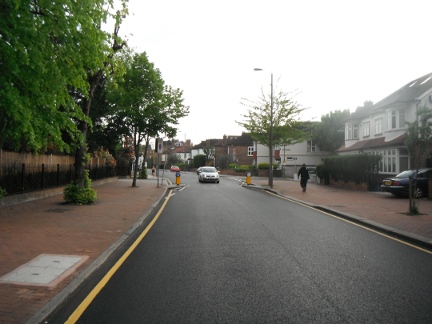
Thanks to Google for streetview image - I've tweaked it a bit as you can see.
I now live near Mitcham Lane, which for those of you who don't know it, it's an A road, and pretty wide as you can see (Original google streetview link). In fact so wide that you can have cars parked on both sides, a central reservation and there is still enough space for lorries, coaches etc to pass each way. 

Using Google's measuring tape, and the satellite view it seems to me that the road is at least 10.5m wide (not including the pavements). 

Crossing this road, on foot, or by bicycle is not straightforward. 

There is clearly the space for 2m wide segregated cycle routes to be placed on the roadway in both directions ensuring that people of whatever age or ability can choose to cycle locally. 

This would help reducing the school run effect on our roads, as providing safe infrastructure such as this would make it much safer for people of all ages to cycle locally (including pupils of our local schools). 

Yes, some of the on-street car parking would need to be removed, but that wouldn't stop access to off-road car parking which several properties have along Mitcham Lane.

The good news for the motoring enthusiasts amongst you is that as the road would keep most of it's motor traffic capacity so even the engineers who think roads are all about motor traffic could be kept happy. (i.e. we don't need to get those engineers to change their views in order for them to do this type of scheme)

Would welcome your views on this before I set up another local online petition. 

Monday, 15 July 2013

Our AM writes "20mph limit won’t necessarily work for Putney"

Over on the excellent PutneySW15.com website, our local London Assembly Member posted a comment earlier today.


His perspective raised a number of queries, which I've put to him and have copied below:

Why would a London-wide 20mph speed limit in your view simply be unworkable? In the past 30mph was the default speed limit with differences for other major roads, how would a 20mph speed limit be different?

I quite agree (with our AM) that the speed limit if amended to 20mph should be done with local resident support. Why can't we follow the lead of other boroughs which are consulting borough wide as to what people's views are? 

With regards to policing and enforcement, stretched local police budgets have resulted in very little enforcement taking place of the current speed limits. Perhaps we could explore community-led enforcement options? 

Given that Wandsworth Council now has direct responsibility for public health, given the positive indicators of our local trials, would it not make sense to look to roll this out across the borough, with local support via a borough wide consultation? 

---------------------------

I've had a prompt response and the key factor according to our Assembly member as to if 20mph can be workable depends on enforcement, be that via the police, or using cameras. This view contradicts the locally gathered evidence in Wandsworth of the two trial 20mph areas, which have seen a drop in the average speed in those areas without (to my knowledge) any further enforcement than that which is done for the roads normally. 

Our council is working on a strategy on 20mph limits for Wandsworth at the moment. If you would like to know more, Wandsworth Living Streets are organising a public meeting happening this Wednesday 17th July, at The Alma Pub. Cllr Russell King (Cabinet member for Transport) will be speaking on a range of issues, so do come along if you are free:

Wednesday 17 July, 7.30pm
The Alma Pub, Upstairs function room, 
499 Old York Road, 
SW18 1TF


Friday, 28 June 2013

Parking - so where can I park my bike?

Fortunately London Cycling Campaign have come up with this nifty little form below which can help you get bike parking near your home or workplace.

Here's the link to the LCC blog: http://lcc.org.uk/articles/cyclehoop-brings-dutch-style-secure-residential-cycle-parking-to-six-london-boroughs

Coming soon to Tooting & Wandsworth I hope.

Wednesday, 26 June 2013

Witness dangerous/inconsiderate driving? What can you do?

This morning, like most mornings, I went for a ride around the neighbourhood before starting work. I work from home, and it's good to get out a bit, stretch the legs etc at the start of the day. Now I'm living in Furzedown, there is a dense network of residential streets through which I can cycle, avoiding busy and unpleasant main roads.

Sadly, there are also a large number of drivers who feel that this network is a good route for them to use as a short cut and drive at speeds which quite frankly I feel are dangerous, and I'm not one of the school children walking to school.

Fortunately for London based people there is now a Road Safe team where if you witness anti-social driving, dangerous driving you can report it, and this Met Police team will follow up on it. Whilst knowledge of this team is spreading through the cycling community, I think a lot of us when walking about town, and in our neighbourhoods will have seen irresponsible/dangerous driving and now you can do something about it.

A few important points:


  • This is not for reporting road collisions
  • Note down the licence plate of the vehicle as soon as possible after witnessing the incident/poor driving/speeding (our memory fades very quickly on details, so if you don't write/record the details immediately, even 30mins later the details will have become fuzzy)
  • When you have a moment visit and log the details http://www.met.police.uk/roadsafelondon/


For too long inconsiderate drivers have been able to seemingly get away with bullying others on our roads. This Road Safe team allows us to report poor driving which hasn't resulted in someone being hurt, but poses a danger to others. We shouldn't have to wait for another person to be killed or injured for changes to be made to our streets, and the same goes for dangerous/irresponsible drivers.

I hope you'll join me in starting to report incidents. Getting a letter through the post from the police reminding you that you have responsibilities as a driver may not work for everyone, but I do think it's a positive step which will help kerb some of the excesses of those drivers that put all of us at risk.

Sunday, 23 June 2013

Getting consensus on a solution to deal with rat-runs

As we hopefully approach the  first implementation of this scheme in Tooting, and having already started to share the concept with other campaigners it was about time I shared the approach more widely. With a bit of luck we should have change on the ground within 18 months of the petition being presented to the council.

Last year I ran a petition looking to make the streets I lived on safer. My petition was different from the ones which had been before it.

100% agreement on the problem

Over 10 years, 3 sets of petitions, 3 sets of public consultations had resulted in little tangible change on the ground. One lady whose house is on the corner of two residential streets, has the wall around her front garden rebuilt regularly as drivers crash into it.

Old approach => no solution

Each of the previous public consultations had proposed solutions devised by the officers. Then they were passed by key stakeholders before finally being presented as a take it or leave it option to local residents.

This type of approach resulted in people choosing to stick with the devil they know, as whilst wanting a solution to the problem, the proposed solution didn't appeal enough for them to support it.

New approach => trial a solution

243 people signed my petition. Whilst some have concerns about the proposed solution, given the recognition of the problem, giving something a go as a solution is very low risk for local residents.


If it works, we can keep the solution. If it doesn't we can roll it back.

Concerns raised:
Where will the traffic go?
I believe that the proposed trial will result in traffic evaporation. (see links below)
Are those who support the petition fully aware of the traffic issues and how this may affect them?
Yes, getting people to sign a petition with a specific ask like this needs explaining. People don't just sign up to things by magic.
How would the emergency services be affected?
All the streets in question are residential. Other boroughs in London have significant filtered permeability schemes in place with which the emergency services work in.
How would the success of the scheme be measured?
By a drop in the volume of motor traffic, and a qualitative survey with local residents.

Technical details:
An Experimental Traffic Order is perfect for this new approach. In the paper the officers highlighted:


“Experimental orders should not be seen as a way of quickly making an order without going through the normal procedures for permanent orders of consultation, consideration of objections and, where required, the holding of a public inquiry before the order can be made. To avoid the possibility of a successful challenge in the High Court, an authority must be able to demonstrate where the element of experiment or uncertainty lies as an experimental order can only be made for the purposes of carrying out an experimental scheme of traffic control.”

The authority must provide a statement explaining why experimental powers are being used, and the Committee should scrutinise and seek approval for such a statement.

I believe that 'traffic evaporation' will take place. Officers and indeed traffic models from the Department for Transport / TfL do not show that traffic evaporation occurs. Indeed, their models show that we will experience growth in motor traffic volumes even when the evidence of the past couple of decades shows their model to be broken.

Using experimental powers are therefore totally justified as until we change our local streets, we don't know how local people will adapt. In trialling we can see and experience how people adapt and see if it results in improving the local environment or not.

In each case there may be local mitigating circumstances which may result in the proposed scheme being successful or not as the case may be.

What can you do?

Use/tweak the template provided for your local streets.
Have a chat with local friends/neighbours to see if they would be keen to try something like this. It's much easier to go out and collect signatures if there are a few of you.
Contact your local councillor and the cabinet member for transport. Check with them how many signatures you need to get. In my case I was told around 25% of local households. This may vary depending on your local council.
Go out and ask people if they'll support it.

Links:

Rat-running time for a different solution (previous blogpost)
http://traffikintooting.blogspot.co.uk/2013/01/rat-running-time-for-different-solution.html

Reclaiming city streets for people. Chaos or Quality of life?
http://ec.europa.eu/environment/pubs/pdf/streets_people.pdf

The concept of traffic evaporation - reallocating road space and 20 mph zones
http://www.hernehillforum.org.uk/campaigns/ruskin-park-area-road-danger-reduction-campaign/concept-traffic-evaporation-reallocating-r

Disappearing Traffic
https://en.wikipedia.org/wiki/Disappearing_traffic

Traffic Evaporation (examples from the USA)
http://www.onestreet.org/resources-for-increasing-bicycling/115-traffic-evaporation

Wednesday, 29 May 2013

Parking in Wandsworth / Tooting

Parking, let's face it, it's a frequent issue which crops up locally (and isn't exclusively a problem limited to Wandsworth). Usually the main issue is that there seems to never be enough space, or at least there isn't right where you want it.

Given these concerns any changes to our streets which involve modifying the current parking arrangements can be fraught. Fortunately for local residents, if you are of the shrinking number who do own or purchase a car, Wandsworth council can facilitate residents' car parking permits where needed. Or, in certain parts of the borough, you can park your car without any further charges required.

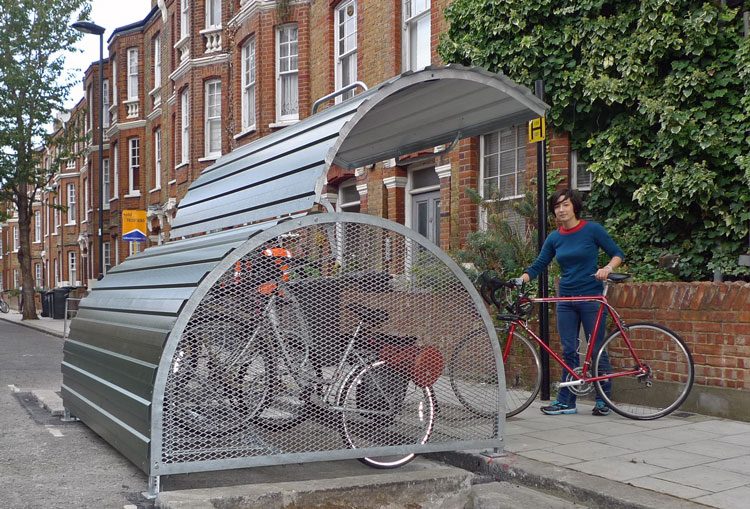
See full specs here: http://www.cyclehoop.com/product/bike-lockers/bike-hangar/

Sadly the same is not yet true if you would like to own a bicycle and park it on the street near your home.

Fortunately Wandsworth council is sympathetic to the needs of people who would like to have the facility shown in the picture above. I'm hopeful that soon they will be a normal part of our streetscape in Wandsworth.

But, to get just a couple of these lockers onto our streets, local residents currently need to get the support of around 25% of their street.

Seems a bit of an overkill to me, as I could buy a car and take up a car parking space without asking any of my neighbours. But to be able to park my bike on the street in either a locker like this, or indeed just having some bike stands on the carriageway requires quite a bit more effort, at present.

There is significant demand for these lockers. Lambeth who have initiated the scheme now have 40 on their streets, with lots more demand. As people see them, they are interested to know how they can have one near their homes.

I'm optimistic that soon, i.e. once the initial few petitions have gone through, Wandsworth council will be able to include the request for bike parking in the same way that residents can request a car parking permit.

Ultimately irrespective of how we travel, the ability to park our vehicles in our streets should not be purely the reserve for private motorised vehicles.

Whilst officially Wandsworth council policy is not to favour any mode of transport over another, the efforts required for parking of one vehicle when compared to others suggest otherwise.

Friday, 24 May 2013

Nightingale Lane - the start of a positive new approach?

The other week I had a very constructive meeting with some council officers regarding another local scheme.

In discussion it transpired that one of the officers had implemented the Nightingale Road scheme. The officer explained that they have seen it in action and it seems to be working as intended. The concepts underpinning the scheme have been brought in from overseas.

I've given some thought to this new approach, and I believe that there are some exciting positives which we as a local community, council and councillors can learn from.

Given that a lot of people have been critical of the scheme I was interested to learn more. I'm a strong believer that we should allow our local representatives and officers the opportunity to trial good ideas from elsewhere. Indeed, this principle is one that I would like to see encouraged. It would allow us to borrow from best practise examples of street design from other parts of the world, so that we don't have to re-invent the wheel.

If you aren't familiar with the area, I took these pictures the other evening. Apologies for the quality of the photos, but you get the idea.

I would highlight the following. The road surface has been smoothed which is great. The width of the carriageway is quite wide. The build outs create a number of "pinch-points". Arguably for significant stretches of the road there is enough space for cycle tracks, particularly if we could reallocate the limited number of car parking bays which exist along this road.


From what I understood, the principle of the new layout is to increase the sense of danger that people have when using the road, thus making road users act in a more responsible manner. The evaluation of the scheme will involve an analysis of RTCs (Road Traffic Collisions), road traffic speeds and volumes and comparisons to pre-scheme collected data. As well as correspondence/comments received from the local community and ward councillors.

Sadly, if we are looking to create streets where people aged from 8 to 80 can view walking or cycling as safe and attractive options I don't believe this type of street design is going to deliver.

From comments received from people who do currently cycle many have commented that they don't feel safer. This is likely to result in fewer people cycling along this route, which statistically is going to drop the number of people on bikes involved in RTCs. I don't think that this type of design presents cycling as an attractive option to travel short trips when compared against other transport options.

We need to adopt new approaches locally to our street design, and be prepared for the council to make mistakes. We also need to ensure that we learn the right lessons, and measure the results of new schemes properly. I hope that the views I'm expressing here can be included in the mix when this scheme is reviewed.

The meeting for which I was principally with the officers for was to discuss a new approach to dealing with rat-running. I'm hopeful that it will work. In the event that it doesn't I'm also hopeful that we will all have learnt from the experience, and can apply the lessons to other streets in our borough.