As we hopefully approach the first implementation of this scheme in Tooting, and having already started to share the concept with other campaigners it was about time I shared the approach more widely. With a bit of luck we should have change on the ground within 18 months of the petition being presented to the council.
Last year I ran a petition looking to make the streets I lived on safer. My petition was different from the ones which had been before it.
100% agreement on the problem
Over 10 years, 3 sets of petitions, 3 sets of public consultations had resulted in little tangible change on the ground. One lady whose house is on the corner of two residential streets, has the wall around her front garden rebuilt regularly as drivers crash into it.
Old approach => no solution
Each of the previous public consultations had proposed solutions devised by the officers. Then they were passed by key stakeholders before finally being presented as a take it or leave it option to local residents.
This type of approach resulted in people choosing to stick with the devil they know, as whilst wanting a solution to the problem, the proposed solution didn't appeal enough for them to support it.
New approach => trial a solution
243 people signed my petition. Whilst some have concerns about the proposed solution, given the recognition of the problem, giving something a go as a solution is very low risk for local residents.
If it works, we can keep the solution. If it doesn't we can roll it back.
Concerns raised:
Where will the traffic go?
I believe that the proposed trial will result in traffic evaporation. (see links below)
Are those who support the petition fully aware of the traffic issues and how this may affect them?
Yes, getting people to sign a petition with a specific ask like this needs explaining. People don't just sign up to things by magic.
How would the emergency services be affected?
All the streets in question are residential. Other boroughs in London have significant filtered permeability schemes in place with which the emergency services work in.
How would the success of the scheme be measured?
By a drop in the volume of motor traffic, and a qualitative survey with local residents.
Technical details:
An Experimental Traffic Order is perfect for this new approach. In the paper the officers highlighted:
“Experimental orders should not be seen as a way of quickly making an order without going through the normal procedures for permanent orders of consultation, consideration of objections and, where required, the holding of a public inquiry before the order can be made. To avoid the possibility of a successful challenge in the High Court, an authority must be able to demonstrate where the element of experiment or uncertainty lies as an experimental order can only be made for the purposes of carrying out an experimental scheme of traffic control.”
The authority must provide a statement explaining why experimental powers are being used, and the Committee should scrutinise and seek approval for such a statement.
I believe that 'traffic evaporation' will take place. Officers and indeed traffic models from the Department for Transport / TfL do not show that traffic evaporation occurs. Indeed, their models show that we will experience growth in motor traffic volumes even when the evidence of the past couple of decades shows their model to be broken.
Using experimental powers are therefore totally justified as until we change our local streets, we don't know how local people will adapt. In trialling we can see and experience how people adapt and see if it results in improving the local environment or not.
In each case there may be local mitigating circumstances which may result in the proposed scheme being successful or not as the case may be.
What can you do?
Use/tweak the template provided for your local streets.
Have a chat with local friends/neighbours to see if they would be keen to try something like this. It's much easier to go out and collect signatures if there are a few of you.
Contact your local councillor and the cabinet member for transport. Check with them how many signatures you need to get. In my case I was told around 25% of local households. This may vary depending on your local council.
Go out and ask people if they'll support it.
Links:
Rat-running time for a different solution (previous blogpost)
http://traffikintooting.blogspot.co.uk/2013/01/rat-running-time-for-different-solution.html
Reclaiming city streets for people. Chaos or Quality of life?
http://ec.europa.eu/environment/pubs/pdf/streets_people.pdf
The concept of traffic evaporation - reallocating road space and 20 mph zones
http://www.hernehillforum.org.uk/campaigns/ruskin-park-area-road-danger-reduction-campaign/concept-traffic-evaporation-reallocating-r
Disappearing Traffic
https://en.wikipedia.org/wiki/Disappearing_traffic
Traffic Evaporation (examples from the USA)
http://www.onestreet.org/resources-for-increasing-bicycling/115-traffic-evaporation
Sunday, 23 June 2013

Wednesday, 29 May 2013
Parking in Wandsworth / Tooting
Parking, let's face it, it's a frequent issue which crops up locally (and isn't exclusively a problem limited to Wandsworth). Usually the main issue is that there seems to never be enough space, or at least there isn't right where you want it.
Given these concerns any changes to our streets which involve modifying the current parking arrangements can be fraught. Fortunately for local residents, if you are of the shrinking number who do own or purchase a car, Wandsworth council can facilitate residents' car parking permits where needed. Or, in certain parts of the borough, you can park your car without any further charges required.
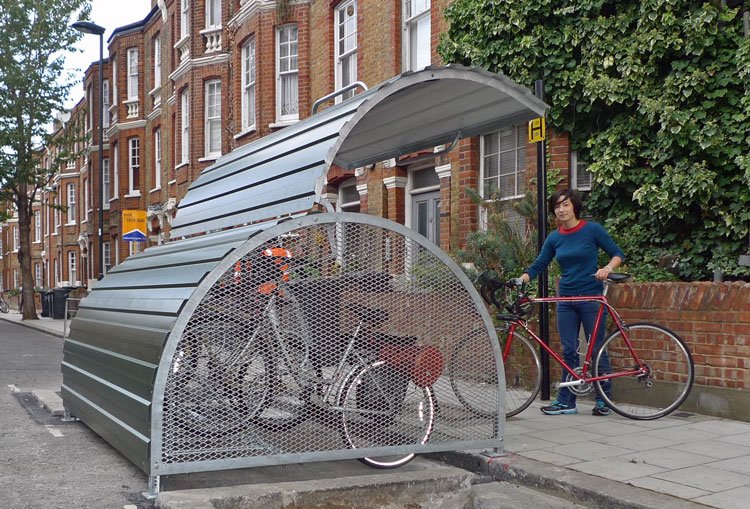
Sadly the same is not yet true if you would like to own a bicycle and park it on the street near your home.
Fortunately Wandsworth council is sympathetic to the needs of people who would like to have the facility shown in the picture above. I'm hopeful that soon they will be a normal part of our streetscape in Wandsworth.
But, to get just a couple of these lockers onto our streets, local residents currently need to get the support of around 25% of their street.
Seems a bit of an overkill to me, as I could buy a car and take up a car parking space without asking any of my neighbours. But to be able to park my bike on the street in either a locker like this, or indeed just having some bike stands on the carriageway requires quite a bit more effort, at present.
There is significant demand for these lockers. Lambeth who have initiated the scheme now have 40 on their streets, with lots more demand. As people see them, they are interested to know how they can have one near their homes.
I'm optimistic that soon, i.e. once the initial few petitions have gone through, Wandsworth council will be able to include the request for bike parking in the same way that residents can request a car parking permit.
Ultimately irrespective of how we travel, the ability to park our vehicles in our streets should not be purely the reserve for private motorised vehicles.
Whilst officially Wandsworth council policy is not to favour any mode of transport over another, the efforts required for parking of one vehicle when compared to others suggest otherwise.
Given these concerns any changes to our streets which involve modifying the current parking arrangements can be fraught. Fortunately for local residents, if you are of the shrinking number who do own or purchase a car, Wandsworth council can facilitate residents' car parking permits where needed. Or, in certain parts of the borough, you can park your car without any further charges required.
 |
| See full specs here: http://www.cyclehoop.com/product/bike-lockers/bike-hangar/ |
Sadly the same is not yet true if you would like to own a bicycle and park it on the street near your home.
Fortunately Wandsworth council is sympathetic to the needs of people who would like to have the facility shown in the picture above. I'm hopeful that soon they will be a normal part of our streetscape in Wandsworth.
But, to get just a couple of these lockers onto our streets, local residents currently need to get the support of around 25% of their street.
Seems a bit of an overkill to me, as I could buy a car and take up a car parking space without asking any of my neighbours. But to be able to park my bike on the street in either a locker like this, or indeed just having some bike stands on the carriageway requires quite a bit more effort, at present.
There is significant demand for these lockers. Lambeth who have initiated the scheme now have 40 on their streets, with lots more demand. As people see them, they are interested to know how they can have one near their homes.
I'm optimistic that soon, i.e. once the initial few petitions have gone through, Wandsworth council will be able to include the request for bike parking in the same way that residents can request a car parking permit.
Ultimately irrespective of how we travel, the ability to park our vehicles in our streets should not be purely the reserve for private motorised vehicles.
Whilst officially Wandsworth council policy is not to favour any mode of transport over another, the efforts required for parking of one vehicle when compared to others suggest otherwise.
Friday, 24 May 2013
Nightingale Lane - the start of a positive new approach?
The other week I had a very constructive meeting with some council officers regarding another local scheme.
In discussion it transpired that one of the officers had implemented the Nightingale Road scheme. The officer explained that they have seen it in action and it seems to be working as intended. The concepts underpinning the scheme have been brought in from overseas.
I've given some thought to this new approach, and I believe that there are some exciting positives which we as a local community, council and councillors can learn from.
Given that a lot of people have been critical of the scheme I was interested to learn more. I'm a strong believer that we should allow our local representatives and officers the opportunity to trial good ideas from elsewhere. Indeed, this principle is one that I would like to see encouraged. It would allow us to borrow from best practise examples of street design from other parts of the world, so that we don't have to re-invent the wheel.
If you aren't familiar with the area, I took these pictures the other evening. Apologies for the quality of the photos, but you get the idea.
I would highlight the following. The road surface has been smoothed which is great. The width of the carriageway is quite wide. The build outs create a number of "pinch-points". Arguably for significant stretches of the road there is enough space for cycle tracks, particularly if we could reallocate the limited number of car parking bays which exist along this road.


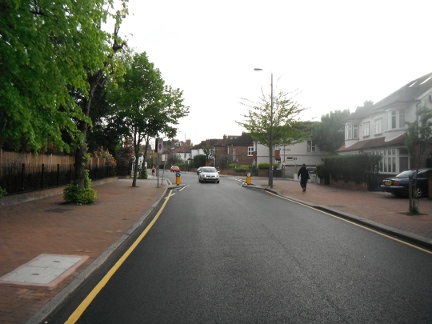


From what I understood, the principle of the new layout is to increase the sense of danger that people have when using the road, thus making road users act in a more responsible manner. The evaluation of the scheme will involve an analysis of RTCs (Road Traffic Collisions), road traffic speeds and volumes and comparisons to pre-scheme collected data. As well as correspondence/comments received from the local community and ward councillors.
Sadly, if we are looking to create streets where people aged from 8 to 80 can view walking or cycling as safe and attractive options I don't believe this type of street design is going to deliver.
From comments received from people who do currently cycle many have commented that they don't feel safer. This is likely to result in fewer people cycling along this route, which statistically is going to drop the number of people on bikes involved in RTCs. I don't think that this type of design presents cycling as an attractive option to travel short trips when compared against other transport options.
We need to adopt new approaches locally to our street design, and be prepared for the council to make mistakes. We also need to ensure that we learn the right lessons, and measure the results of new schemes properly. I hope that the views I'm expressing here can be included in the mix when this scheme is reviewed.
The meeting for which I was principally with the officers for was to discuss a new approach to dealing with rat-running. I'm hopeful that it will work. In the event that it doesn't I'm also hopeful that we will all have learnt from the experience, and can apply the lessons to other streets in our borough.
In discussion it transpired that one of the officers had implemented the Nightingale Road scheme. The officer explained that they have seen it in action and it seems to be working as intended. The concepts underpinning the scheme have been brought in from overseas.
I've given some thought to this new approach, and I believe that there are some exciting positives which we as a local community, council and councillors can learn from.
Given that a lot of people have been critical of the scheme I was interested to learn more. I'm a strong believer that we should allow our local representatives and officers the opportunity to trial good ideas from elsewhere. Indeed, this principle is one that I would like to see encouraged. It would allow us to borrow from best practise examples of street design from other parts of the world, so that we don't have to re-invent the wheel.
If you aren't familiar with the area, I took these pictures the other evening. Apologies for the quality of the photos, but you get the idea.
I would highlight the following. The road surface has been smoothed which is great. The width of the carriageway is quite wide. The build outs create a number of "pinch-points". Arguably for significant stretches of the road there is enough space for cycle tracks, particularly if we could reallocate the limited number of car parking bays which exist along this road.
From what I understood, the principle of the new layout is to increase the sense of danger that people have when using the road, thus making road users act in a more responsible manner. The evaluation of the scheme will involve an analysis of RTCs (Road Traffic Collisions), road traffic speeds and volumes and comparisons to pre-scheme collected data. As well as correspondence/comments received from the local community and ward councillors.
Sadly, if we are looking to create streets where people aged from 8 to 80 can view walking or cycling as safe and attractive options I don't believe this type of street design is going to deliver.
From comments received from people who do currently cycle many have commented that they don't feel safer. This is likely to result in fewer people cycling along this route, which statistically is going to drop the number of people on bikes involved in RTCs. I don't think that this type of design presents cycling as an attractive option to travel short trips when compared against other transport options.
We need to adopt new approaches locally to our street design, and be prepared for the council to make mistakes. We also need to ensure that we learn the right lessons, and measure the results of new schemes properly. I hope that the views I'm expressing here can be included in the mix when this scheme is reviewed.
The meeting for which I was principally with the officers for was to discuss a new approach to dealing with rat-running. I'm hopeful that it will work. In the event that it doesn't I'm also hopeful that we will all have learnt from the experience, and can apply the lessons to other streets in our borough.
Tuesday, 9 April 2013
Folly of 'half-price' car parking in Tooting
Whilst an understandable response to local businesses petition, unfortunately this is likely to be £35,000 of public money which could have been much better spent.
See this article:
http://www.wandsworthguardian.co.uk/news/10342138.New___35_000_initiative_brings_half_price_parking_to_Tooting/
Back in the Autumn a petition went forward from local businesses regarding car parking charges. A significant number of them are of the opinion that low cost car parking provision is essential for the well-being of the high street, and that empty car parking bays on neighbouring streets is a sign that the pricing is too high, thus deterring shoppers from their stores.
In spite of the evidence of a local report* commissioned on their behalf only a few years ago which shows over 80% of their customers, walk, use public transport and walk, or cycle and then walk into their businesses.
Less than 1 in 5 shoppers drives a car, or is a passenger in a car or van to Tooting to shop, and then, yes they walk into local businesses.
*See the report on the link below 'Tooting Town Centre Gap Analysis study 2009'
http://ww3.wandsworth.gov.uk/committ/%28S%28j14jbcuxyyc5p245j4bn0omj%29%29/documents/s9480/09-1005%20-%20Experian%20Gap%20Analysis%20Study%20report.pdf
Granted not everyone walks, some people are not able to, and use mobility scooters, but the principle remains.
I fully understand that the council needs to listen to the demands of it's residents and businesses. However I also believe, that they have a duty to evaluate the evidence, and make decisions which reflect that evidence base.
The only outcome which will be clearly measurable by the drop in car parking charges will be the number of bays which are available. Given that a minority of shoppers choose to visit Tooting in this way the difference to businesses will be negligible at best.
One result may well be an increase in the numbers of people encouraged to drive to Tooting, instead of using the excellent public transport links, and indeed walking or cycling. This will result in a less pleasant shopping experience for all as the roads become more congested, noisy and more polluted.
I want our town centre to thrive, and really want to support local businesses, as I believe the council does too. However, I do think when beliefs fly in the face of the evidence that we have a duty to challenge them and if we go ahead with trials have robust ways of measuring the outcomes. I don't know how this trial will be measured, and I'm not convinced there is a way that it can be effectively measured.
If you know how it could be, do post a comment below.
Also if you have 30mins it's well worth listening to this podcast on Freakonomics Radio 'Parking is Hell':
http://transportationnation.org/2013/03/15/freakonomics-radio-parking-is-hell/
See this article:
http://www.wandsworthguardian.co.uk/news/10342138.New___35_000_initiative_brings_half_price_parking_to_Tooting/
Back in the Autumn a petition went forward from local businesses regarding car parking charges. A significant number of them are of the opinion that low cost car parking provision is essential for the well-being of the high street, and that empty car parking bays on neighbouring streets is a sign that the pricing is too high, thus deterring shoppers from their stores.
In spite of the evidence of a local report* commissioned on their behalf only a few years ago which shows over 80% of their customers, walk, use public transport and walk, or cycle and then walk into their businesses.
Less than 1 in 5 shoppers drives a car, or is a passenger in a car or van to Tooting to shop, and then, yes they walk into local businesses.
*See the report on the link below 'Tooting Town Centre Gap Analysis study 2009'
http://ww3.wandsworth.gov.uk/committ/%28S%28j14jbcuxyyc5p245j4bn0omj%29%29/documents/s9480/09-1005%20-%20Experian%20Gap%20Analysis%20Study%20report.pdf
Granted not everyone walks, some people are not able to, and use mobility scooters, but the principle remains.
I fully understand that the council needs to listen to the demands of it's residents and businesses. However I also believe, that they have a duty to evaluate the evidence, and make decisions which reflect that evidence base.
The only outcome which will be clearly measurable by the drop in car parking charges will be the number of bays which are available. Given that a minority of shoppers choose to visit Tooting in this way the difference to businesses will be negligible at best.
One result may well be an increase in the numbers of people encouraged to drive to Tooting, instead of using the excellent public transport links, and indeed walking or cycling. This will result in a less pleasant shopping experience for all as the roads become more congested, noisy and more polluted.
I want our town centre to thrive, and really want to support local businesses, as I believe the council does too. However, I do think when beliefs fly in the face of the evidence that we have a duty to challenge them and if we go ahead with trials have robust ways of measuring the outcomes. I don't know how this trial will be measured, and I'm not convinced there is a way that it can be effectively measured.
If you know how it could be, do post a comment below.
Also if you have 30mins it's well worth listening to this podcast on Freakonomics Radio 'Parking is Hell':
http://transportationnation.org/2013/03/15/freakonomics-radio-parking-is-hell/
Thursday, 21 March 2013
Safer Lorries - open letter to Wandsworth Council
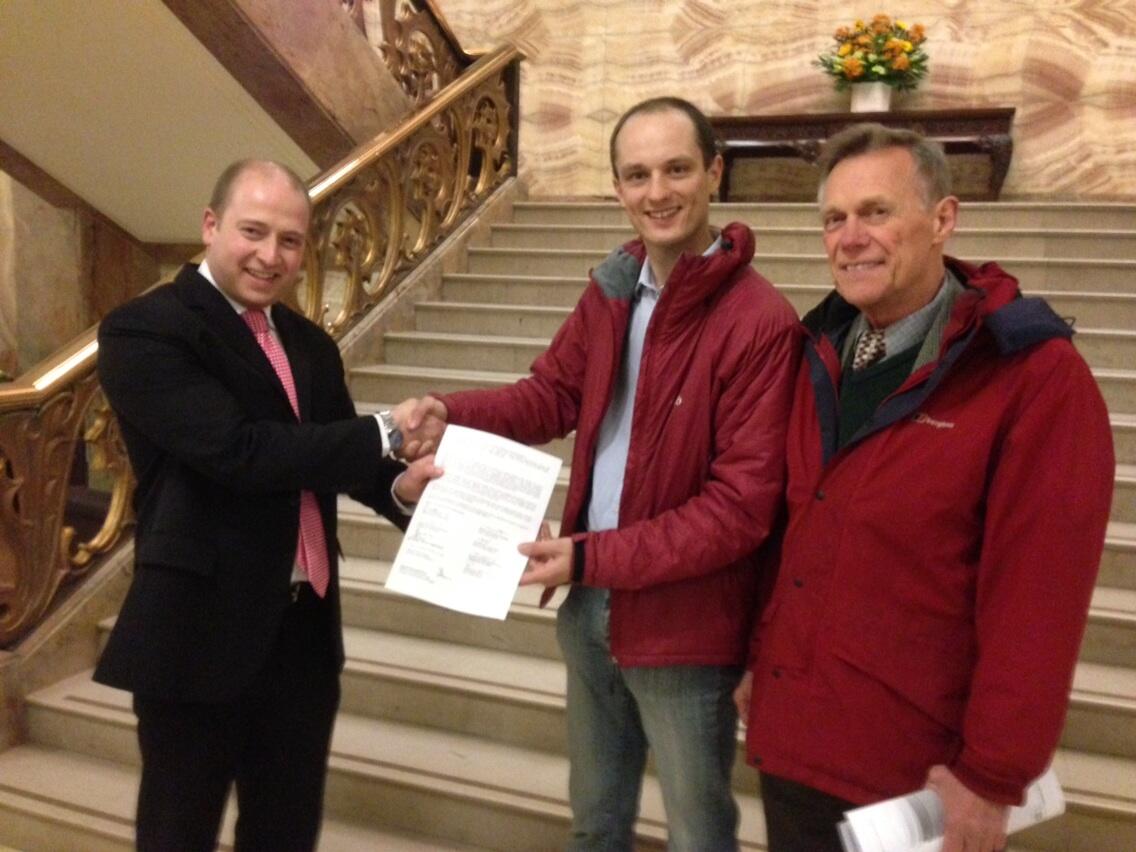 |
| Cllr Russell King, Jon Irwin (Co-chair WEF), Robert Molteno (Secretary Wandsworth Living Streets) |
Yesterday evening I went to Wandsworth Town Hall, and presented an open letter to the council.
As some of you may already know, lorries and HGVs are disproportionately involved in fatal collisions on our streets. In part due to their design, where many of the drivers have no visibility up to 4m in front of their cab.
In Wandsworth there have been 3 elderly people who have been killed by lorries in the past year, two incidents happening very close to me in Tooting.
Feb 17 2012 - Man decapitated after being run over by lorry
May 18 2012 - Elderly man dies after being crushed under truck
Sept 28 2012 - Pensioner killed by lorry in Putney High Street
Aside from lorries being involved in all 3 fatalities, each of the men involved were of advanced age. Unfortunately these deaths, in part due to the age of the victims, in part to the ubiquity of death and injuries on our streets, can too often become 'invisible'.
London Cycling Campaign (LCC) launched a 'Safer Lorries' campaign earlier this year, however, as we know from our local recent history not only cyclists are at risk from lorries on our streets. With this in mind, together with other local groups, the letter below was drafted.
I hope that the widespread support shown including; Age UK Wandsworth, Friends of the Earth Wandsworth, the Putney Society, Transition Town Tooting, Wandsworth Cycling Campaign, Wandsworth Living Streets, the Wandsworth Society, and Wandsworth Environment Forum, will help illustrate the strong desire from the local community for our council to take action which will deliver safer streets for residents, visitors and people who work in the borough alike in the long term.

We can't bring people back to life, but we can learn how to reduce road danger, in doing so help change our streets to make them safer for all. Yesterday also saw London Cycling Campaign publish the following proposals of how safer lorries could be designed. This is how LCC suggest they could look like based on existing technology and design principles:
 |
| Graphic produced by http://www.releasethechicken.com/ for LCC |
You can view an animation of the lorry here.
Thursday, 14 March 2013
From Balham High Road to Balham Boulevard
A vision who's time has come. Incredibly excited about this project, which I put forward in the autumn to Wandsworth Council.
This afternoon I saw this tweet:
In case you are wondering what I'm excited about, don't worry hopefully the following pictures will explain. If you aren't familiar with this part of London, here is a streetview picture to give you an idea.
View Larger Map
I visited Paris last year, and took a picture of this, as I thought that this kind of idea could be replicated here in London.

So I took to my spreadsheet and google satellite view. Measured up the street, and then did this roughly to scale map. On the left is the crossing where Balham Tube station is, so under the bridge for those who know it.

Then, having a plan of what space is available, I played around, and came up with the plans in the pictures below.


The parking bays are set away from the pavement. The black dots along the service road, are to illustrate that if you are in a car/van, you will need to exit once you've been to the shop, and re-join the main road. Doing the scheme in this way results in a very small reduction in road capacity (technical term for how many motor vehicles the road can hold).
I checked with Wandsworth Cycling Campaign @Wandscyclist and Wandsworth Living Streets @WandsLS first to iron out any potential issues. Now it seems that Balham Town Centre Partnership (@Balhamtcp), and Balham Town Centre Manager (@Balhamtcm) are now on-board.
This afternoon I saw this tweet:
Great meeting with @balhamtcm and chairs of @balhamtcp. Total support for the Balham Boulevard scheme. Full steam ahead.
— Russell King (@WandsworthRKing) March 14, 2013
In case you are wondering what I'm excited about, don't worry hopefully the following pictures will explain. If you aren't familiar with this part of London, here is a streetview picture to give you an idea.
View Larger Map
I visited Paris last year, and took a picture of this, as I thought that this kind of idea could be replicated here in London.
So I took to my spreadsheet and google satellite view. Measured up the street, and then did this roughly to scale map. On the left is the crossing where Balham Tube station is, so under the bridge for those who know it.
Then, having a plan of what space is available, I played around, and came up with the plans in the pictures below.
The light blue is what I'm terming a 'service road'. It will be
essentially segregated cycle route most of the time, but does allow
people in cars/vans to use it when doing deliveries, or dropping into
the shops/cafes/restaurants.
The parking bays are set away from the pavement. The black dots along the service road, are to illustrate that if you are in a car/van, you will need to exit once you've been to the shop, and re-join the main road. Doing the scheme in this way results in a very small reduction in road capacity (technical term for how many motor vehicles the road can hold).
I checked with Wandsworth Cycling Campaign @Wandscyclist and Wandsworth Living Streets @WandsLS first to iron out any potential issues. Now it seems that Balham Town Centre Partnership (@Balhamtcp), and Balham Town Centre Manager (@Balhamtcm) are now on-board.
Update 21st April 2013
I was sent an email earlier from someone who lives in Balham. They received a Wandsworth Conservatives Borough newsletter today which includes the following text:
"Your views on Balham Boulevard plans
Wandsworth Council is pulling together plans to create a Paris-style boulevard on the wide stretch of Balham High Road between Balham Station and Ritherdon Road.
The plans, which will be submitted to Transport for London, will separate cyclists from other traffic and enable a more continental-style 'cafe culture'. We'd like to hear what you think of the plans - please get in touch using the form below or the details above."
The email that they have asked for feedback to is: heretohelp@wandsworthconservatives.com
If you are supportive of the proposals, please do let them know. Worthwhile also copying in your local councillor and our London Assembly Member Richard Tracey as TfL will need to give the go-ahead for this project.
richard.tracey@london.gov.uk
Good to see that campaigning can deliver results.
Tuesday, 22 January 2013
Rat-running time for a different solution
Seeing the news published by the council today that "Public say no to Earlsfield traffic changes" has spurred me on to write this.
The problem faced by the residents of Earlsfield is one which people face across the UK, and no doubt in other countries too. As main roads become congested with more and more (motor) traffic, those drivers seek alternative routes to travel along. In the case of Earlsfield, those alternative routes are clearly residential streets.
My understanding of the current scenario is as follows:
End result = Residents reject proposed changes, problem remains, time and money wasted.
My main issues with this process is that the public consultation totally fails to consult with the public in question. There is no exchange of views, both from the officers with the residents or vis-a-versa. Also the process takes so long, that the impetus from the original petition may have been forgotten by the time these changes are proposed. The changes are also usually proposed as permanent, which can be very unsettling if you feel that they may not work.
A different approach - A possible Solution
In light of a similar outcome on my residential streets, I conducted a petition which asks the council to trial a solution. In excess of 90% of the people asked were happy to sign. They can see that there is a problem, we don't all agree that my proposed solution will work, but we all recognise that if we don't change anything then nothing will change.
Here is my petition form
I'm waiting for the officers locally to report back. I'm confident that the changes will work, but to really be sure, we need to see how people react with them on the ground.
I'd really like to help others in Wandsworth improve their streets. On my patch, 3 consultations have been done in 10 years. That is a lot of time wasted as well as money, with all the problems still with us.
The right solutions could have been proposed before, but we are naturally hesitant/concerned about change, and whilst change could be good people often think 'better the devil I know'.
If the proposed change is temporary, to allow people the opportunity to experience something different without the fear presented by permanent change and it works, they will want to keep it.
If you'd like some help putting together something like this for your streets, let me know. If several different people could work on similar petitions for their local streets, we could change the streets quite quickly with a lot of local support.
Drop me a line if you are interested.
The problem faced by the residents of Earlsfield is one which people face across the UK, and no doubt in other countries too. As main roads become congested with more and more (motor) traffic, those drivers seek alternative routes to travel along. In the case of Earlsfield, those alternative routes are clearly residential streets.
My understanding of the current scenario is as follows:
- Resident speaks to local Councillor (Cllr)
- Cllr tells resident to do a petition to show support
- Resident collects signatures for their petition
- Resident returns petition to Cllr
- Cllr presents petition at full council
- Next transport committee meeting, petition noted, officers asked to work on it.
- Depending on officer workload, several committee meetings later, report presented recommending a public consultation.
- Data gathered if needs be, proposed solution worked up by highways officers.
- Consultation goes out to key stakeholders first, then shared with wider public.
- Local residents are given a take it or leave it option, which proposes change to stop the problem.
End result = Residents reject proposed changes, problem remains, time and money wasted.
My main issues with this process is that the public consultation totally fails to consult with the public in question. There is no exchange of views, both from the officers with the residents or vis-a-versa. Also the process takes so long, that the impetus from the original petition may have been forgotten by the time these changes are proposed. The changes are also usually proposed as permanent, which can be very unsettling if you feel that they may not work.
A different approach - A possible Solution
In light of a similar outcome on my residential streets, I conducted a petition which asks the council to trial a solution. In excess of 90% of the people asked were happy to sign. They can see that there is a problem, we don't all agree that my proposed solution will work, but we all recognise that if we don't change anything then nothing will change.
Here is my petition form
I'm waiting for the officers locally to report back. I'm confident that the changes will work, but to really be sure, we need to see how people react with them on the ground.
I'd really like to help others in Wandsworth improve their streets. On my patch, 3 consultations have been done in 10 years. That is a lot of time wasted as well as money, with all the problems still with us.
The right solutions could have been proposed before, but we are naturally hesitant/concerned about change, and whilst change could be good people often think 'better the devil I know'.
If the proposed change is temporary, to allow people the opportunity to experience something different without the fear presented by permanent change and it works, they will want to keep it.
If you'd like some help putting together something like this for your streets, let me know. If several different people could work on similar petitions for their local streets, we could change the streets quite quickly with a lot of local support.
Drop me a line if you are interested.
Subscribe to:
Posts (Atom)